
Disclosure: I'm a Solutions Architect at DigitalOcean, so when I mention DigitalOcean products it's an informed-insider view, not a neutral one — I flag those moments clearly and keep the analysis vendor-neutral wherever the topic allows. The opinions here are my own.
A version of this article was published on the DigitalOcean Community.
A repeatable method for choosing inference models by evaluating on your own data, with first-hand cost figures from DigitalOcean serverless. The method is provider-agnostic; DigitalOcean specific numbers are cited to source.
Model choice moves cost by orders of magnitude
Model selection, not infrastructure, not prompt optimization, not batching strategy is the single biggest lever on both quality and cost in a GenAI deployment. Claude Sonnet 4.6 lists $3.00/M input; Claude Haiku 4.5 lists $1.00/M: a 3× spread on a simple classification task. Against a capable open-weight model on DigitalOcean Serverless Inference, that gap widens to 36× on identical token shapes (measured in Multi-Model API Cost Governance with the Inference Router, June 2026).
These are two separate comparisons, not one escalating figure: the 3× spread is within Anthropic's own lineup, and the 36× figure is a distinct, separately measured comparison against an open-weight model on DO Serverless. Keep them separate if you cite either number on its own elsewhere.
If the smaller model produces equivalent quality for your specific task, every day on the bigger model is overpayment, not by percentages, but by multiples.
Pricing note: Token rates reflect June 2026 list prices from provider docs and DigitalOcean Inference pricing. Confirm live rates before you budget. Model lineups also move fast; confirm whether a newer flagship release has superseded the models referenced here before quoting this comparison.
The selection framework: accuracy floor first, then cost
The correct sequence is "find the accuracy floor for your task, then find the smallest model that clears it."

Pour the candidates through your accuracy floor; keep the smallest model that clears it.
- Define your accuracy floor: the minimum acceptable performance on the metrics that matter. Not "as good as possible," but the threshold below which the product breaks.
- Evaluate on your own data: representative samples from your production distribution, not the benchmark's.
- Start small, work up: models that pass your eval are candidates; the cheapest candidate wins.
- Revisit when models update: what required Sonnet 6 months ago may now be achievable with Haiku.
Translation: use COMET not BLEU, and NMT not an LLM for bulk
Translation exposes a fundamental evaluation flaw: the metrics that are easy to compute often don't measure what matters.
BLEU correlates poorly with human judgment
BLEU(bilingual evaluation understudy) counts n-gram overlaps between model output and a reference translation. It's fast and deterministic. It's also a poor predictor of quality for anything requiring nuance.
COMET (Crosslingual Optimized Metric for Evaluation of Translation) is a neural metric trained on human judgments. It correlates substantially better with how native speakers evaluate quality and can invert BLEU rankings. A model scoring higher on BLEU sometimes scores lower on COMET.
For any serious translation evaluation, COMET should be the primary metric. BLEU is a sanity check.
NMT wins on bulk; LLMs win on nuance
For high-volume translation, the speed gap is decisive. Google's NMT engine delivers results in milliseconds, up to 20× faster than LLMs. DeepL performs comparably at high throughput.
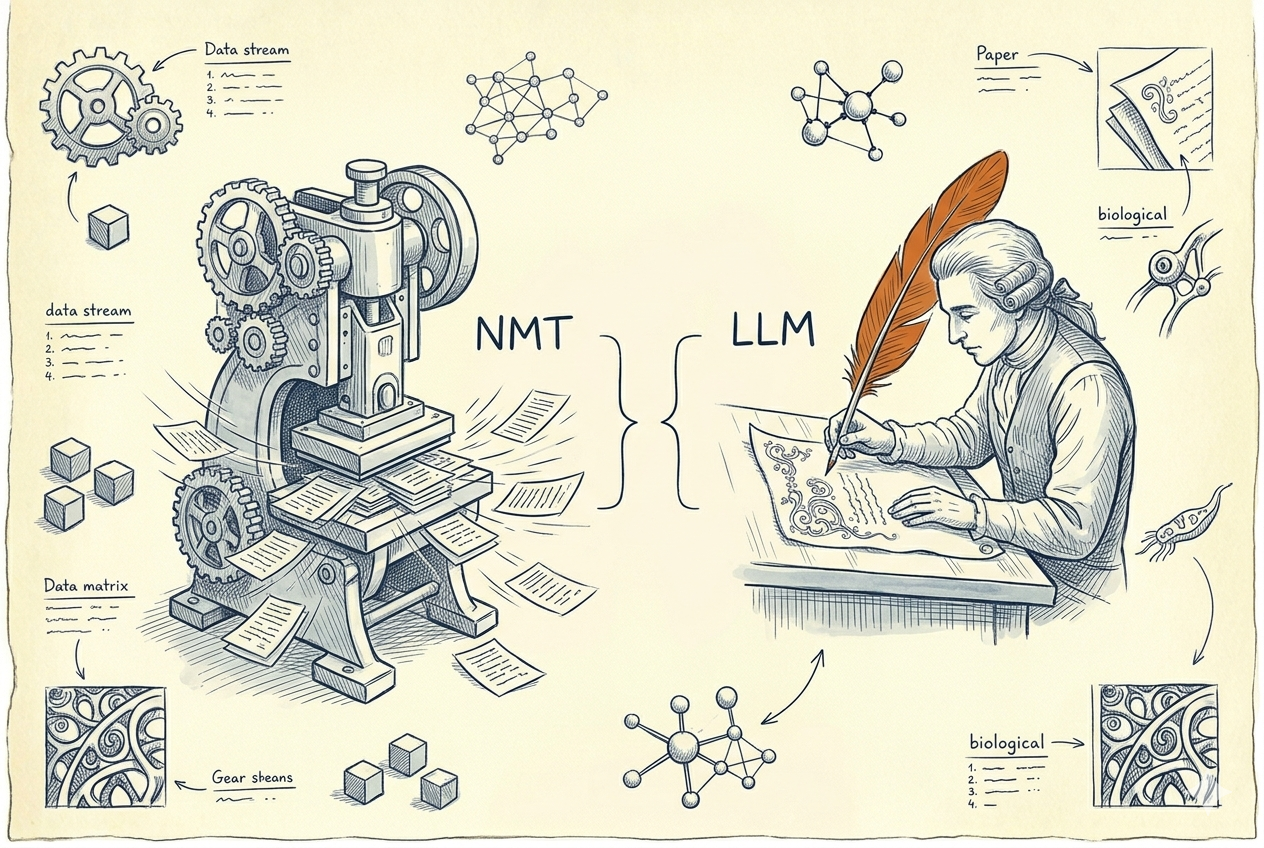
Bulk translation: NMT is the stamping press; an LLM is the careful scribe, slower but better with nuance.
LLMs win on long-form context, idioms, low-resource languages, and brand-sensitive copy. Lokalise's blind study compared five engines across EN→DE/PL/RU with native-speaker pairwise comparison and found Claude 3.5 at the highest "good" rating (78%). Rapidata's dataset (DeepL versus DeepSeek-R1/Llama/Mixtral, 51,000+ native speakers, publicly available on Hugging Face) found neither category dominates across all language pairs and content types.
| Use case | Recommended approach |
|---|---|
| High-volume, repetitive documents | DeepL or Google NMT as primary engine |
| Marketing copy, brand voice, tone-sensitive content | LLM (Claude) for final adaptation |
| Low-resource language pairs | Fine-tuned NLLB-200 3.3B often outperforms generic 7-8B LLMs |
| Domain-specific terminology (legal, medical) | Fine-tuned model on domain corpus |
| Real-time user-facing translation at scale | NMT; LLMs too slow for synchronous UX |
For low-resource and domain-specific pairs, a fine-tuned 3.3B specialist still outperforms a generic 7-8B generalist. The main blocker in AI localization is trust, not technology; post-editing workflows exist because production teams aren't ready to publish LLM output without a human checkpoint, regardless of benchmark scores.
What we measured: five models, three languages, one eval harness
To put numbers behind the framework, we ran a translation evaluation on DigitalOcean Model Evaluations (public preview). The setup: 50 translation prompts across English→German, English→Traditional Chinese, and English→Polish, covering everyday, formal, idiomatic, and technical content. Each prompt includes a human-written reference translation. The judge (Claude Opus 4.6) scores Ground Truth Faithfulness (GTF), measuring semantic equivalence to the reference on a 0–1 scale. Star metric pass threshold: 0.80.
Five models, same dataset, same judge, same system prompt, temperature=0:
| Model | Input price/M | GTF avg | German | zh-TW | Polish | Output tokens (50 prompts) |
|---|---|---|---|---|---|---|
| DeepSeek V4 Flash | $0.112 | 0.781 | 0.825 | 0.794 | 0.720 | 1,367 |
| Claude Sonnet 4.6 | $3.00 | 0.784 | 0.818 | 0.788 | 0.744 | 3,529 |
| GLM-5.2 | $1.05 | 0.768 | 0.794 | 0.771 | 0.738 | 68,876 |
| Qwen3-32B | $0.25 | 0.710 | 0.747 | 0.724 | 0.653 | 43,006 |
| Llama 3.3 70B | $0.65 | 0.704 | 0.788 | 0.665 | 0.656 | 2,943 |
DeepSeek V4 Flash matches Sonnet's quality (GTF 0.781 vs 0.784) at 27× lower input price, and slightly outscores Sonnet on German and Traditional Chinese. It also produces the cleanest output: 1,367 tokens total, zero preamble. Sonnet added "Here is the translation:" on 14 of 50 prompts despite explicit instructions not to.
GLM-5.2 scores well on quality (0.768) but generated 68,876 output tokens which is 50× more than DeepSeek V4 Flash. At $4.40/M output, verbosity erases the input-price advantage. Qwen3-32B has the same problem (43,006 tokens). This is the verbosity multiplier from the first article in this series on Why Your LLM Bill Is 3× What You Expected in numeric form: model selection is not just about per-token rate, it's about how many tokens the model produces.
Polish scores lowest across all five models (0.653–0.744 vs 0.747–0.825 for German), consistent with the low-resource language thesis above.
One prompt shows the failure mode behind that gap. Source: "Let's not beat around the bush, the project is behind schedule and we need to course-correct." Reference: Nie owijajmy w bawełnę, projekt jest opóźniony i musimy skorygować kurs. Qwen3-32B (GTF 0.4) rendered the idiom as Nie kręćmy się w kółko ("let's not go in circles", a different idiom) and translated "behind schedule" literally as za harmonogramem instead of the natural opóźniony. Claude Sonnet 4.6 (GTF 0.8) matched the idiom and phrasing exactly, deviating only on a harmless paraphrase of "course-correct." Cheaper models clear the bar on literal and technical text, then miss on idiom.
The dataset, system prompt, and raw result files are available here for reproducibility. To run this evaluation on your own prompts refer to How to Evaluate Models in the DigitalOcean Documentation.
RAG pipelines: evaluate the full chain, not the model alone
RAG evaluation fails most often because teams evaluate only the generation step. The pipeline has three failure points:
- Embedding quality: does the retrieval system surface the right chunks?
- Retrieval precision: are the top-k results actually relevant?
- Generation faithfulness: does the model stick to retrieved context, or hallucinate?
Faithfulness (groundedness) is the dominant quality signal. A model that confidently generates plausible-but-wrong answers outside the retrieved context is dangerous regardless of benchmark scores.
Practical selection criteria for RAG:
- Evaluate retrieval and generation separately
- Measure hallucination rate on held-out examples with known ground truth
- Prompt caching of stable context (system prompt + RAG template) is the dominant cost lever: a well-cached RAG pipeline sees 70-80% of input tokens served from cache at 10% of the base input price. Structure prompts for cacheability from the start; retrofitting is expensive.
For most RAG, mid-tier models (Claude Sonnet, GPT-4o mini) close the quality gap with frontier models because faithfulness is a controllable behavior with good prompting; it doesn't require maximum model intelligence. Escalate to a frontier model only if faithfulness still fails your eval after prompt tuning.
Code generation: private codebases always underperform benchmarks
The canonical benchmark is SWE-bench, specifically SWE-bench Verified (500 human-validated Python tasks) for screening, and increasingly SWE-bench Pro for harder signal.
SWE-bench Verified has contamination problems
OpenAI deprecated reporting against it in February 2026 after audits found benchmark tasks with solutions leakable from issue text, and models recalling file-path and release-note details from training data in a majority of probed cases. Top models score 70%+ on Verified. On SWE-bench Pro, a contamination-resistant alternative from Scale AI, top models score around 23%.
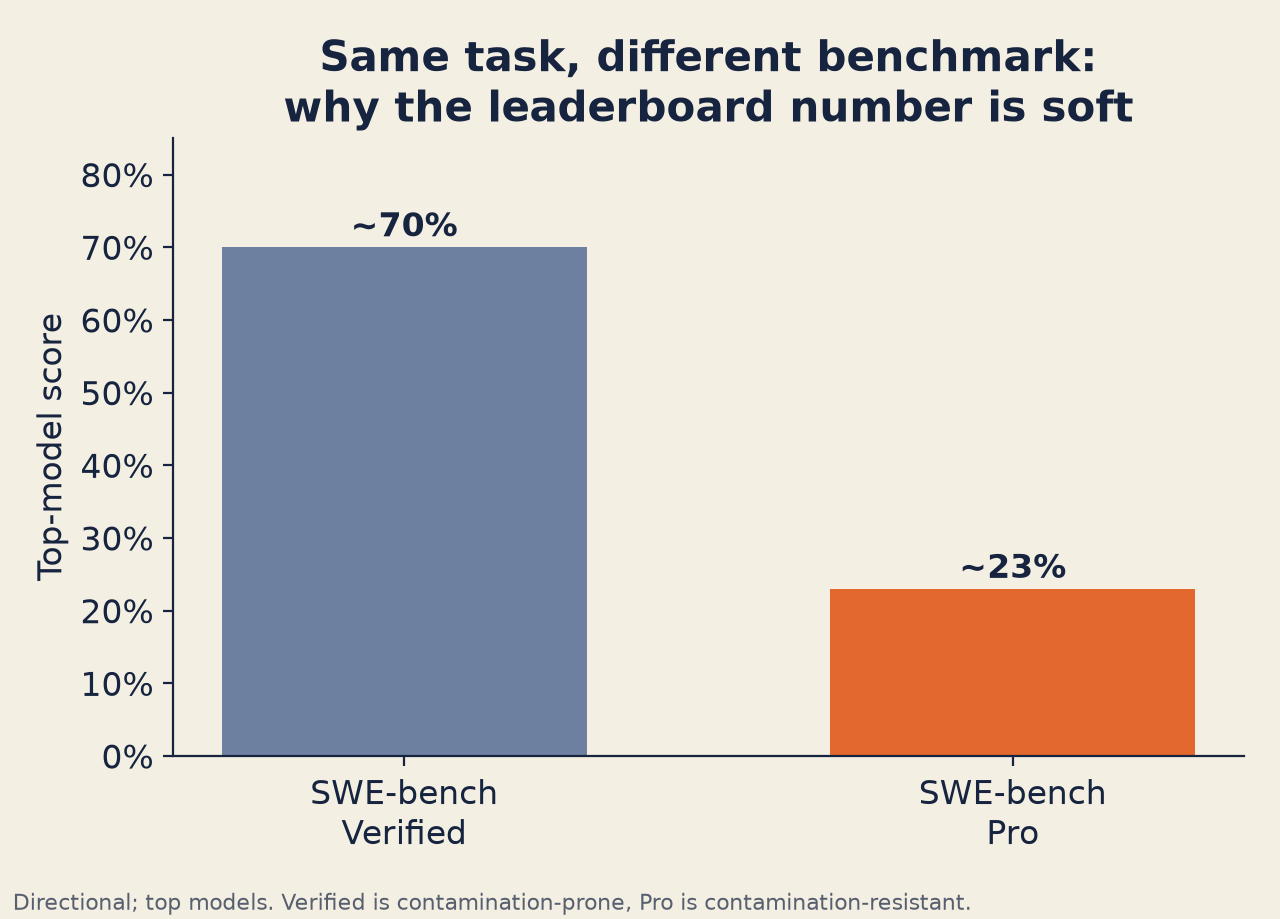
Same task domain, different benchmark: the contamination-resistant set tells a very different story.
Your codebase is the only honest benchmark
Models that perform well on SWE-bench do so on public Python repositories with common patterns. Your private codebase has different conventions, abstractions, and test structures. Performance is always lower; the question is how much, and it varies across models.
Practical code-generation selection:
- Use SWE-bench Verified and Pro as screening filters to eliminate poor performers
- Run a private evaluation harness: representative tasks from your codebase with known correct solutions
- Include LiveCodeBench: problems released after model training cutoffs make contamination structurally difficult
- Measure on your top languages and frameworks specifically
Use a frontier model for complex, multi-file changes. For scoped edits, test generation, and boilerplate, a mid-tier model usually clears the bar at a fraction of the cost.
Customer support: TTFT dominates the UX
For customer-facing chat, model quality debates are secondary to Time to First Token (TTFT), the delay between request and the first character of response.
Users perceive 500ms TTFT as instant and 2-second TTFT as slow. The content of the response barely registers until the speed is acceptable.
We measured TTFB (time to first byte, a proxy for TTFT) on a support-ticket classification prompt across four models on DigitalOcean Serverless Inference (inference.do-ai.run, July 2026, 3 runs each, median reported):
| Model | TTFB median | Input price/M | vs Sonnet |
|---|---|---|---|
| Llama 3.3 70B | 389ms | $0.65 | 3.6× faster, 4.6× cheaper |
| Claude Haiku 4.5 | 655ms | $1.00 | 2.2× faster, 3× cheaper |
| Qwen3-32B | 1,040ms | $0.25 | 1.4× faster, 12× cheaper |
| Claude Sonnet 4.6 | 1,416ms | $3.00 | baseline |
Three runs per model is a thin sample for a metric this sensitive to network jitter and time-of-day load. Treat these multiples as directional rather than definitive. Llama 3.3 70B delivers sub-400ms TTFB at $0.65/M, 3.6× faster and 4.6× cheaper than Sonnet. For a customer-support chatbot where the user is watching the cursor, that is simultaneously better UX and lower cost. Sonnet's 1.4-second TTFB is approaching the threshold where users perceive delay.
Implications:
- Smaller, faster models deliver better UX even if output quality is marginally lower; the experience is dominated by TTFT
- Semantic and prompt caching of repeated FAQ-style queries is the dominant cost optimization: the same questions appear hundreds of times; caching stable context reduces per-query cost dramatically
- Streaming matters: 300ms to first token feels faster than a complete response after 1.5 seconds, even at the same total completion time
For classification-style support tasks (intent routing, escalation detection, sentiment tagging), the accuracy floor is reachable by models much smaller and cheaper than frontier.
Benchmarks are screening filters, not verdicts
Four caveats before committing to a model based on public benchmarks:
MMLU is saturated. State-of-the-art models cluster within 2-4% accuracy, making it nearly useless for distinguishing current frontier models.
Same model, different scores across harnesses. Two teams running the same model with different prompting formats and answer-extraction logic can report scores that differ by 10-15%. The evaluation methodology is part of the result.
SWE-bench contamination. The gap between Verified (70%+) and Pro (23%) illustrates how dramatically contamination inflates scores.
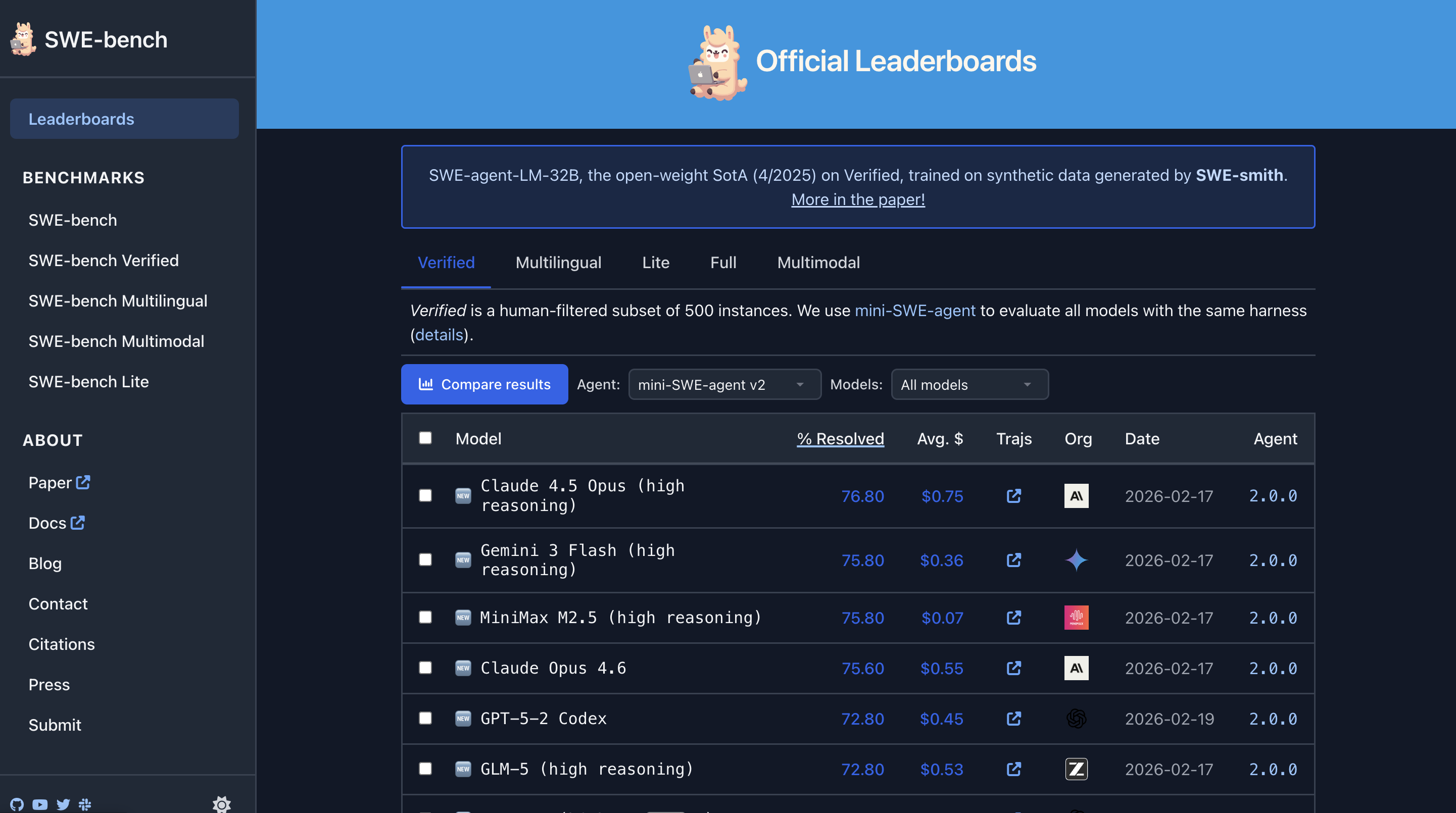
A public SWE-bench leaderboard. Treat the ranking as directional; the same model scores differently depending on the evaluation harness.
Your data is the only authoritative signal. Every benchmark was built from someone else's distribution. A model that ranks second on a public benchmark may outperform the top-ranked model on your specific task. The only way to know is to evaluate on your own data.
A repeatable model-selection workflow
So here is the repeatable model-selection workflow that you can use to choose the right model for your inference use case:
- Define your accuracy floor: the actual minimum threshold, not aspirational
- Pick your evaluation metric: COMET for translation, faithfulness for RAG, pass rate on your own harness for code, TTFT + task accuracy for support
- Evaluate smallest-to-largest: start with the cheapest viable model, work up until you clear your floor
- Set a re-evaluation cadence: model tiers evolve quickly
The output is a decision matrix: model X for tasks of type A, model Y for type B, with escalation logic to model Z when confidence is low.
DigitalOcean's Inference Router automates this: routing requests across model tiers based on task complexity without custom routing logic. The decision matrix becomes configuration, not code. The June 2026 live runs in Multi-Model API Cost Governance measured a 39.6% cost reduction vs Sonnet-only and 63.7% vs Opus-only on a mixed classify/Q&A/reasoning traffic split, purely from routing, no prompt or model changes. The deeper architectural story will be covered in the next article in this series.
In case you haven't, please read the first article in this series on Why Your LLM Bill Is 3× What You Expected to understand the cost implications of model selection.
References
- How to Evaluate Models (DigitalOcean Model Evaluations, translation eval methodology)
- Multi-Model API Cost Governance with the Inference Router (DigitalOcean, June 2026 live runs)
- Model Evaluations: Prove Your Routing Policy Actually Works (DigitalOcean)
- What is the best LLM for translation? (Lokalise)
- Rapidata Translation Benchmark: DeepL vs DeepSeek-R1/Llama/Mixtral (HuggingFace)
- NLLB-200 3.3B Model (Meta / HuggingFace)
- SWE-bench Pro Leaderboard (Scale AI)
- Why SWE-bench Verified No Longer Measures Frontier Coding Capabilities (OpenAI, February 2026)
- LiveCodeBench (Contamination-resistant code benchmark)
- Anthropic API Pricing
- DigitalOcean Inference Pricing
- How to Use Inference Router (DigitalOcean Documentation)
This is Article 2 in a 5-part series on LLM inference in production. Article 1 covers the hidden cost multipliers behind an inference bill. Article 3 covers prompt caching in practice. Article 4 covers multi-provider routing architecture. Article 5 examines total cost of ownership for a full AI stack.


