Disclosure: I'm a Solutions Architect at DigitalOcean, so when I mention DigitalOcean products it's an informed-insider view, not a neutral one — I flag those moments clearly and keep the analysis vendor-neutral wherever the topic allows. The opinions here are my own.
I am preparing for the telc Deutsch B1 exam, and the part I worry about is the oral one: sixteen
minutes, two candidates and an examiner, and no time to look anything up. Practice partners
are hard to find at 11 p.m. in Munich, so I built one. Losreden (the code lives in a repo called sprechtest) runs a mock telc oral exam
in the browser: an examiner who keeps the structure and the clock, a second "candidate" who
argues with you, and a report with telc's own criteria and points at the end. I use it every day.
This post covers how it is built on LiveKit Agents 1.8.11, the five problems that cost me the most time, the trade-offs I made, and what one practice costs. Part 2 is about one problem on its own: when an AI partner should start talking to someone who pauses to think. Every number comes from a run log, a commit or a config file in the repository. Where I describe how LiveKit behaves inside, I say whether I read it in the docs or observed it in the installed SDK and my logs.
TL;DR
- Losreden is a mock telc B1 oral exam in the browser, built on LiveKit Agents 1.8.11: one
AgentSessionwith two voices (a scripted examiner and an LLM partner), a hidden observer, and a scorer that reports telc's own criteria. - Every model I tried ignored "one to three sentences". Cutting the reply in code (
llm_node) raised the candidate's share of the words from 54 / 42 / 48 % to 71 / 62 / 74 % across the three parts. - Validate an instrument where it will run. A smoothed frame clock beat arrival stamps on localhost (5 ms vs 25 ms SD) and lost on LiveKit Cloud (90 ms vs 3–5 ms).
- Silent defaults cost the most debugging time: agents ignoring other agents (
participant_kinds), andset_attributes()doing nothing withoutcan_update_own_metadata. - Latency: 1.34 s median
e2e_latencyover 31 partner turns, most of it a deliberate one-second wait. - Cost: a whole 16-minute practice measured $0.70; the LLM judge is the largest item at about 40 %.
Why build it at all
The telc B1 oral exam has three parts. Teil 1 is getting to know each other (about 3 minutes). In Teil 2 the two candidates have read opposite opinions on a topic: each reports theirs, and then they discuss it (about 6 minutes). Teil 3 is planning something together (about 6 minutes). telc allows an Einzelprüfung, where one examiner moderates and a second examiner plays your partner. That format suits software: one scripted voice for the moderator, one LLM voice for the partner.
What I wanted from a practice tool:
- The real structure and timing, with telc's examiner phrases, not a free chat.
- A partner who talks like a B1 candidate and leaves room for me to talk.
- Feedback on telc's criteria: Ausdrucksfähigkeit, Aufgabenbewältigung, Formale Richtigkeit, and Aussprache, each in bands A–D, with points out of 75.
- No stored audio. My voice goes to speech recognition and nowhere else.
The architecture
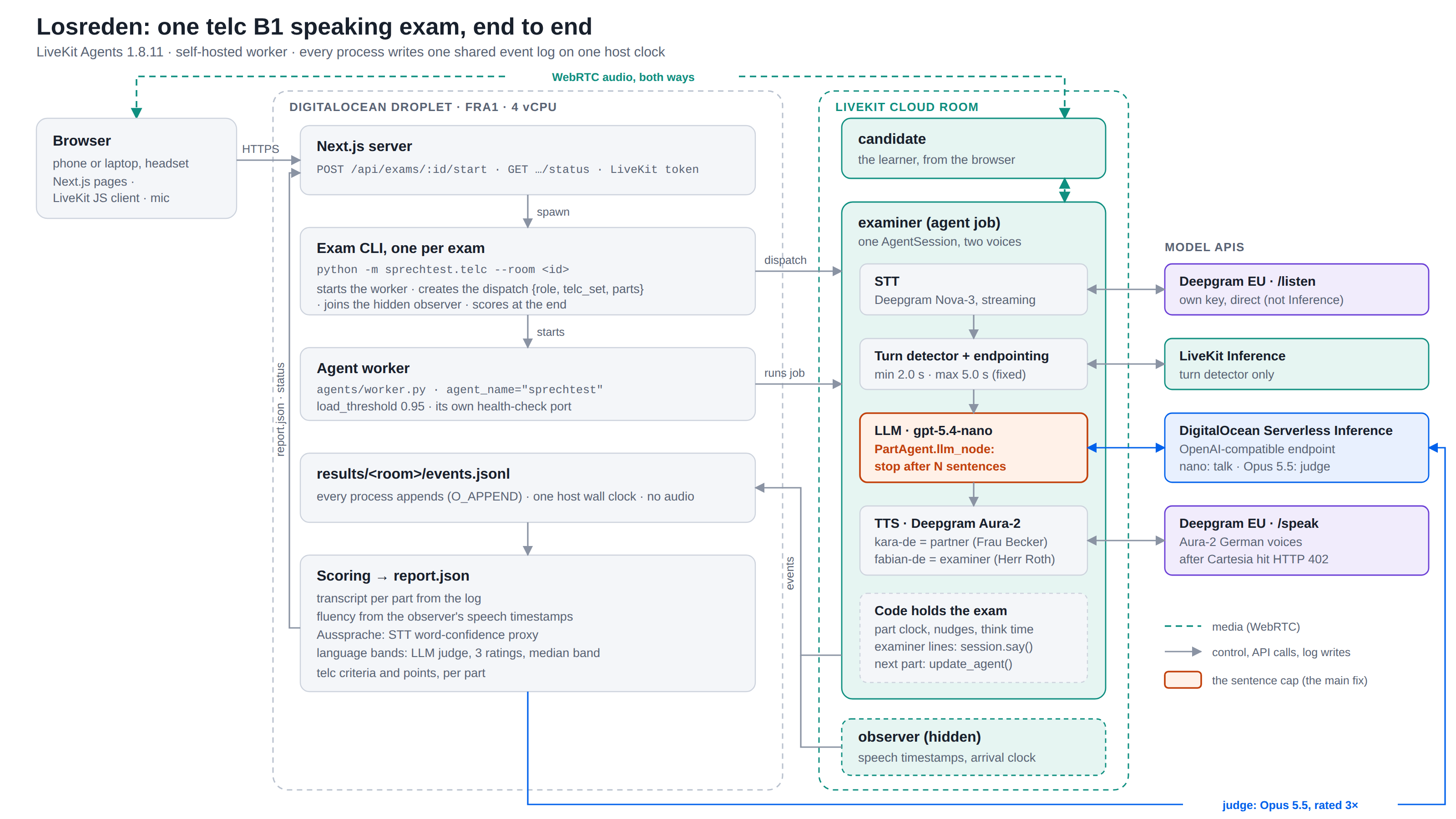
One exam, from click to report:
- The browser talks to a small Next.js server: log in, pick a task set, read the task sheet during the preparation time, press start.
POST /api/exams/<id>/startspawns one exam CLI per exam:python -m sprechtest.telc --candidate human --room <id>. The CLI starts an agent worker (agents/worker.py, registered asagent_name="sprechtest"), creates an explicit dispatch with metadata{role, telc_set, parts}, joins a hidden observer, and waits for the exam to end.- The browser joins the LiveKit Cloud room as
candidatewith a token from the server. - The examiner job is a single
AgentSession: Deepgram Nova-3 STT → LiveKit's turn detector →gpt-5.4-nano→ Deepgram Aura-2 TTS. It has two voices: Herr Roth, the scripted examiner (aura-2-fabian-de), and Frau Becker, the LLM partner (aura-2-kara-de). - Every process appends to one
events.jsonlwithO_APPEND, stamped with the same host clock: the CLI, the agent, the observer. No audio is stored, only text and timestamps. - When the examiner says the closing line, the CLI scores the log: the transcript per part,
fluency from the observer's timestamps, a pronunciation proxy from Deepgram's word confidence,
and the language bands from Claude Opus 5.5 as judge, rated three times, median band per
criterion. The web app reads
report.json.
Models and where they run:
| Job | Model | Route |
|---|---|---|
| Speech recognition | Deepgram Nova-3 | direct, Deepgram EU endpoint, own key |
| Voices | Deepgram Aura-2 (German) | direct, Deepgram EU endpoint |
| Turn detection | LiveKit turn detector | LiveKit Inference |
| Partner / examiner LLM | openai-gpt-5.4-nano | DigitalOcean Serverless Inference (OpenAI-compatible) |
| Judge | anthropic-claude-opus-5.5 | DigitalOcean Serverless Inference |
I work at DigitalOcean, which is why the models run there. The DigitalOcean endpoint is
OpenAI-compatible, so the LLM is LiveKit's openai.LLM plugin with a different base_url. Every model block in config/default.yaml takes via: digitalocean | inference | direct. That one design choice paid for itself twice, as you will see below.
One session, two roles
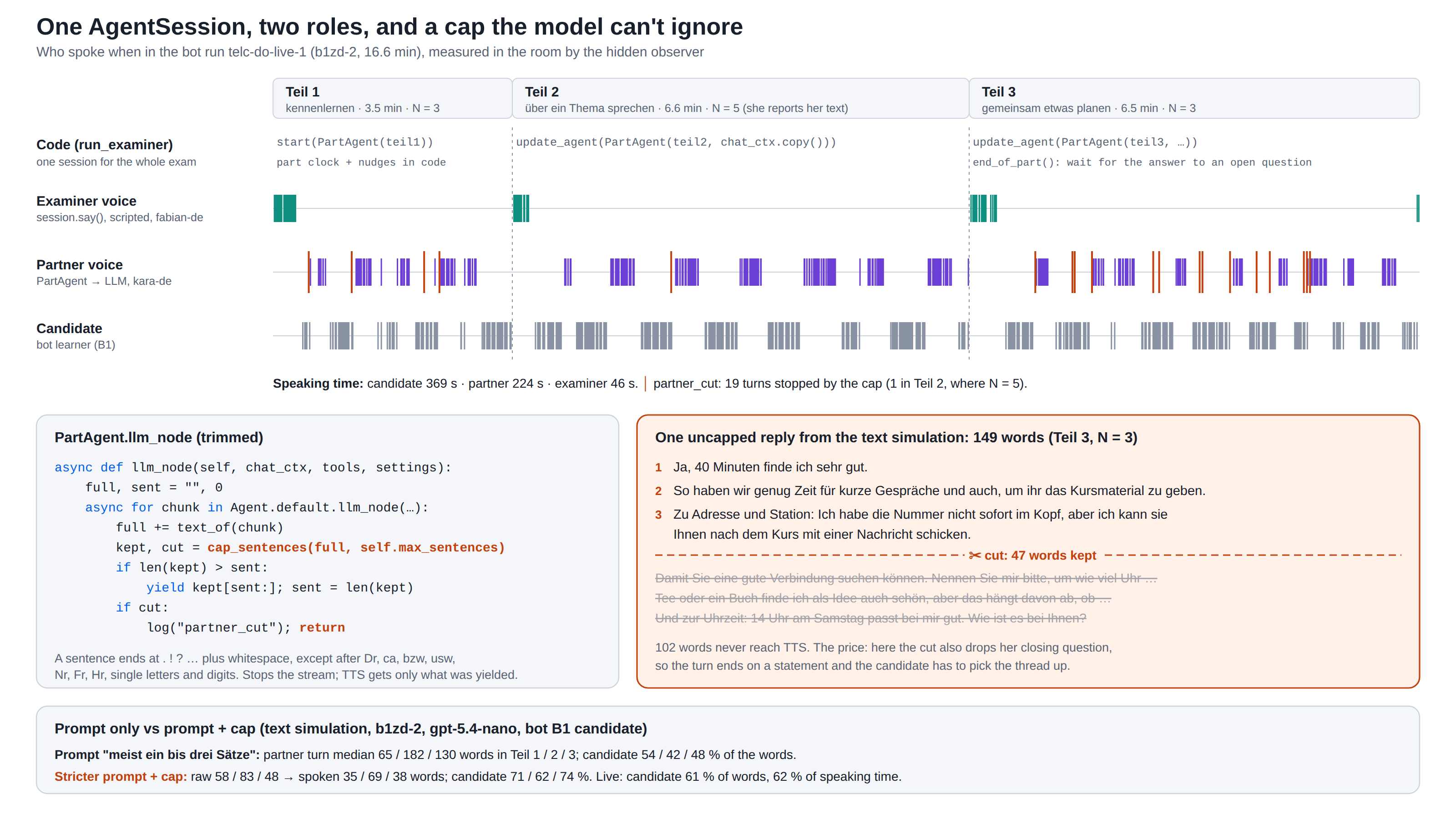
The examiner's lines are fixed text from telc's practice test, so they do not go through the LLM:
session.say(text, audio=<examiner TTS stream>, add_to_chat_ctx=False, allow_interruptions=False). Each part is its own PartAgent with that part's task and the
partner's own task sheet. At a part change the code calls
session.update_agent(PartAgent(next_part, chat_ctx=current.chat_ctx.copy())), so Frau Becker
remembers what you told her in Teil 1. The clock is code, not prompt: each part runs for its
telc minutes and then ends at the next pause.
Five problems, and what fixed them
1. Every model ignored "one to three sentences"
Symptom. In the live A2·B1 run (telc-smoke-a2b1) the partner spoke as many words as
the candidate: 778 against 782. In an exam where you are being assessed, that is half your
speaking time gone.
Root cause. The prompt said "in kurzen Beiträgen (meist ein bis drei Sätze)". I ran the partner
against a simulated B1 learner in text (tests/text_sim_telc.py) with six models. Every one
first summarised what the candidate had just said, then added its own point. With gpt-5.4-nano
her median turn was 65, 182 and 130 words in Teil 1, 2 and 3; GPT-4.1 gave 54 / 118 / 93; Claude
5.5 Haiku 100 / 77 / 69. A stricter prompt ("never summarise, at most 3 short sentences") helped
but did not hold: nano's raw replies were still 58 / 83 / 48 words.
Fix. Cut the reply in code. PartAgent overrides llm_node, feeds the streamed text through
cap_sentences(), yields only the complete sentences it keeps, and returns after sentence N.
N is 3, except in B1 Teil 2 (5, because she has to report her magazine text) and A2·B1 Teil 3
(4, where she argues an opinion). A sentence ends at . ! ? … followed by whitespace, with
exceptions for "Dr.", "ca.", "bzw.", ordinals and the like. Because only kept text is yielded, TTS
never sees the rest. The cap adds nothing to the time to first audio: the first sentence streams
straight through.
Evidence. Same task, same model, same bot (commit 300e27e): spoken turns dropped to
35 / 69 / 38 words and the candidate's share of the words rose from 54 / 42 / 48 % to
71 / 62 / 74 %. In the live run telc-do-live-1 the cap fired 19 times (once in Teil 2, where N
is 5), and the candidate had 61 % of the words (1,201 vs 762) and 62 % of the speaking time
measured in the room (369 s vs 224 s).
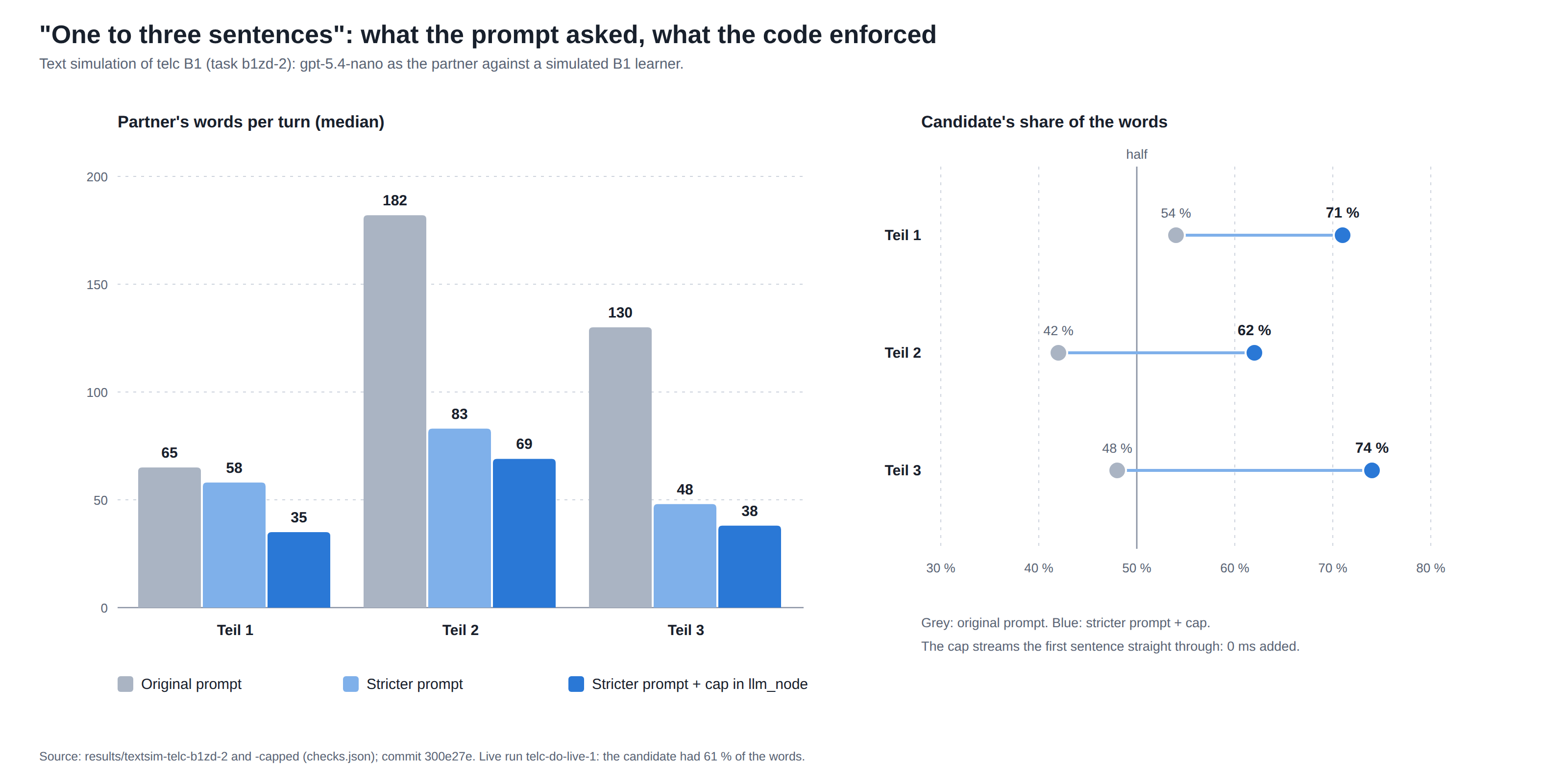
The cap has a cost, and the two-roles diagram above shows it: in one 149-word reply it kept 47 words and also dropped her closing question, "Wie ist es bei Ihnen?". The turn then ends on a statement. For an exam that trade is right. The candidate is supposed to carry the conversation.
2. The nudge that measured silence from one side
Symptom. telc says the examiner steps in "carefully" when a conversation stalls. My first
version had the partner ask an open question after 12 s of silence. In telc-smoke-1 it fired
42 times in one exam (8, 15 and 19 in the three parts), and the partner talked over the bot.
Root cause. "Silence" was measured from the candidate's last word, so the partner's own speech
counted as the candidate being silent. The logged silent_s grew from 17 s to 184 s across the
exam: every partner turn produced the next nudge.
Fix. last_activity is updated when either side starts or stops speaking, the nudge needs
user_state != "speaking" and agent_state == "listening", and there are at most 2 per part
(should_nudge() in agents/examiner.py, commit dea9405).
Evidence. The next two live runs, telc-smoke-a2b1 and telc-do-live-1, logged zero
telc_nudge events. (While writing this I found the docstring said "23 nudges"; the log says 42.
It is fixed.)
3. A clock validated on localhost was wrong on Cloud
Symptom. The fluency score depends on the hidden observer: it subscribes to every audio track and timestamps speech onsets and offsets. I validated two ways of timestamping against a test signal. On the local dev server, a smoothed frame clock beat raw arrival times (absolute SD 5 ms vs 25 ms).
Root cause. On LiveKit Cloud this reversed: the smoothed clock was off by 90 ms SD, arrival times by 3–5 ms. Over a real network, delivery gaps and jitter-buffer adaptation break the "continuous samples" assumption behind smoothing. Gap measurements passed in both modes (slope 0.998–1.001), so only an absolute-time check caught it.
Fix. observer.timestamping: arrival, validated on Cloud. The lesson I keep: validate the
instrument where it will run.
4. Silent defaults: agents that cannot hear agents, and attributes that never arrive
Symptom. Two things fail with no error at all: an agent that should listen to another agent hears nothing, and participant attributes that one side sets never reach the other.
Root cause (found by reading the installed SDK and the token code, not from the docs).
RoomOptions.participant_kinds defaults to SIP and standard participants, so an agent session
ignores other agents. My bot candidate is an agent, so the examiner would never have heard it. And
the tokens I minted lacked the can_update_own_metadata grant, so set_attributes() silently did
nothing. Roles only resolved because the code fell back to the participant identity.
Fix. participant_kinds=ALL_KINDS (standard, SIP and agent) in agents/common.py, and the
grant in lk.py. Losreden now relies on attributes for the role handshake and for the
sprechtest.voice attribute the web page uses to light up the right speaker card.
5. The free tier shaped the architecture
Symptom. In early tests on the free plan, two calls at once got HTTP 429 on the STT handshake,
the session closed with recoverable=False, and a bot waited for a reply that never came. Later
the Cartesia voices stopped mid-setup with HTTP 402.
Root cause. As I read LiveKit's plan page on 2026-11-08, the Build plan's Inference allows 5 concurrent STT and 5 TTS connections and $2.50 of usage a month, shared across a user's free projects. Cartesia's free credit ran out within an hour.
Fix. Configuration, not code: models.stt.via: direct sends STT to Deepgram's EU endpoint
with my own key, and the voices became Deepgram Aura-2 on the same key. That also kept the
candidate's audio in the EU for STT. The turn detector stays on LiveKit Inference. The one thing
lost: Aura-2's German voices have no speed control, so the "speak slower for A2" knob does nothing
until Cartesia comes back.
Four smaller ones
- The answer in the wrong part. A part could end right after the partner asked a question, so
the candidate's answer was spoken under the next part's introduction and scored there.
end_of_part()now waits for the answer to an open question (up to 20 s) before it moves on (commit2eaafd9). Intelc-do-live-1no answer was cut off at a part change. - CPU on a 4-vCPU droplet. Three live voice calls at once pushed the load average to 20 and the
measured latencies drifted; py-spy put most of the time in per-frame FFI plumbing, not my code. So
the server runs one live call at a time (
webapi.capacity(),MAX_CALLS = 1) and queues the next learner. The worker'sload_thresholdis 0.95, because the framework's production default of 0.7 turned exam calls away while the machine was busy. - The status race. A finished exam sometimes showed "no report": the status route checked for
the report first and the process second, and a report written between the two checks looked
missing. Checking the process first fixed it (commit
86dd2e1). - The 2.8-second click. I clicked "Goethe" on the dashboard and nothing happened for about three
seconds. Every dashboard and new-exam page asked a small Python command for the exam catalog, and that
command imported
sprechtest.agents.commonfor one string constant. That pulled inlivekit.agents, which took 1.4 s to import (its inference module loads the wholeopenaitype tree, plus telemetry), 2.5 s for the whole import.python -X importtimefound it in one run. The constant moved to a module that imports nothing,livekit.apiis now imported only by the token command, the web keeps the catalog until a YAML file changes, and in-app links show a progress bar. A call went from 2.8 s to 0.6 s, and the dashboard-to-new-exam click from about 3 s to 0.1 s on staging (commits5e42857,7ba21b7). The lesson for anything that shells out per request: measure the import, not just the work.
The latency budget
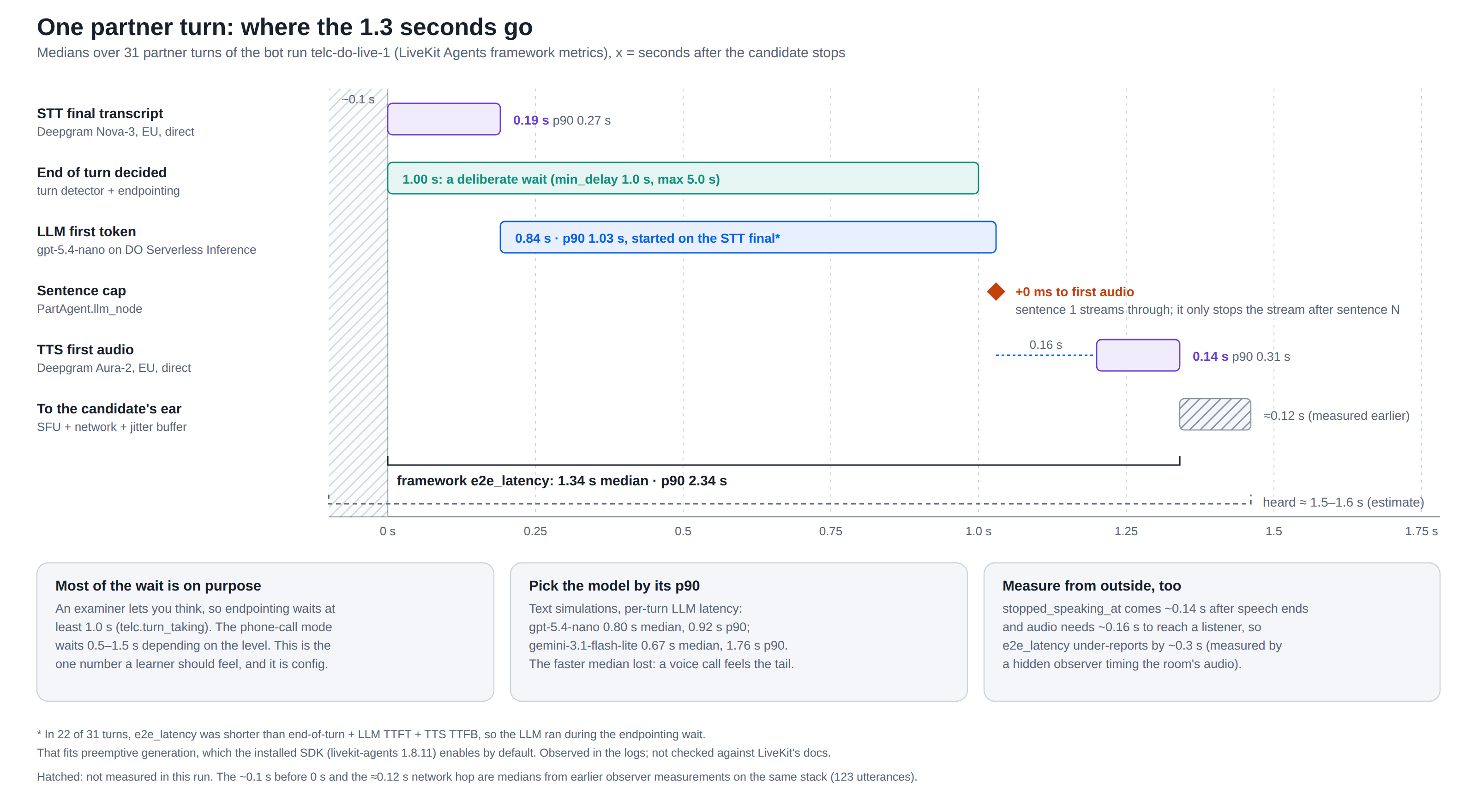
Over the 31 partner turns of telc-do-live-1, the framework's e2e_latency was 1.34 s median
(p90 2.34 s). The biggest item is a deliberate one-second wait: an examiner lets you think, so
endpointing waited at least 1.0 s in this run (telc.turn_taking). It now waits 2.0 s, and part 2
explains why. The LLM's time to first token was 0.84 s median (p90 1.03 s) and TTS first audio
0.14 s (p90 0.31 s).
Those do not add up to 1.34 s, and the logs show why: in 22 of 31 turns, e2e_latency was shorter
than end-of-turn + TTFT + TTFB. The LLM had started on the STT final, during the endpointing wait.
That fits preemptive generation, which the installed SDK enables by default. I saw it in the logs;
I did not check it against the docs.
Two numbers are missing from the framework's view. Earlier measurements with the same observer
found that stopped_speaking_at comes about 0.14 s after the speech really ends, and the audio
needs about 0.16 s more to reach a listener. So what the candidate hears is closer to 1.5–1.6 s. That is an
estimate, not a measurement from this run.
Trade-offs
| Decision | What I chose | What it costs | Evidence |
|---|---|---|---|
| One session or two agents | One AgentSession, examiner via say() with its own TTS | Two voices from one participant; the browser needs a sprechtest.voice attribute to know who speaks | agents/examiner.py |
| Prompt or code for turn length | Prompt and a cap in llm_node | Sometimes cuts her closing question | Candidate share 54/42/48 % → 71/62/74 % |
| Deepgram direct or LiveKit Inference | Direct, EU endpoint, own key | Separate billing; Inference STT is listed at $0.0048/min vs $0.0077 direct | config/default.yaml, 429s and 402s above |
| Choosing the LLM | By p90, not median | Gemini 3.1 Flash Lite had the faster median | nano 0.80 s / 0.92 s p90; Gemini 0.67 s / 1.76 s p90 (text sims) |
| Trusting framework metrics | Keep a hidden observer next to them | One more participant and process per exam | e2e_latency under-reports by ~0.3 s (observer measurements) |
| Privacy or pronunciation | No audio stored; Aussprache from STT word confidence | It is a proxy: microphones, noise and names lower it too | observer.store_audio: false; report caveats |
| CLI per exam or worker pool | A CLI and worker per exam | Slow start, one call per droplet at a time | web/src/lib/server/py.ts, webapi.capacity() |
| One judge rating or three | Three in parallel, median band | 3× judge tokens | Three ratings differed by at most one band on one criterion |
| Opus or a cheaper judge | Opus 5.5, until teachers have rated | About 40 % of a whole exam's cost | On six stored runs Sonnet 5.5 scored 7 points lower on average, Haiku 5.5 10; Opus against itself agreed on 91 % of bands |
| How long she waits | Fixed min_delay 2.0 s, false_interruption_timeout 3.0 s | She answers about 1 s later | She cut into 13 % of a learner's pauses instead of 50 % (part 2) |
What one practice costs
Since 10 November every run writes a usage.json: STT seconds, TTS characters per voice, LLM and
judge tokens from the framework's metrics events, multiplied by list prices checked on 2026-11-09
(config/prices.yaml: Deepgram Nova-3 $0.0077/min, Aura-2 $0.030 per 1k characters, nano $0.20 /
$1.25 per million tokens, Opus 5.5 $4 / $20, LiveKit $0.0005 per participant-minute, turn detector
$0.50 per 1k requests). The two runs below are bot runs. A bot candidate has its own STT, TTS and
LLM, so I took its share out to get what a person's exam costs.
| Practice | STT | TTS | LLM | Judge (3×) | LiveKit | Turn detector | Total |
|---|---|---|---|---|---|---|---|
| telc B1 Teil 1 (3.5 min) | 0.027 | 0.040 | 0.004 | 0.176 | 0.005 | 0.006 | $0.26 |
| telc B1 whole exam (16 min) | 0.124 | 0.217 | 0.038 | 0.277 | 0.024 | 0.023 | $0.70 |
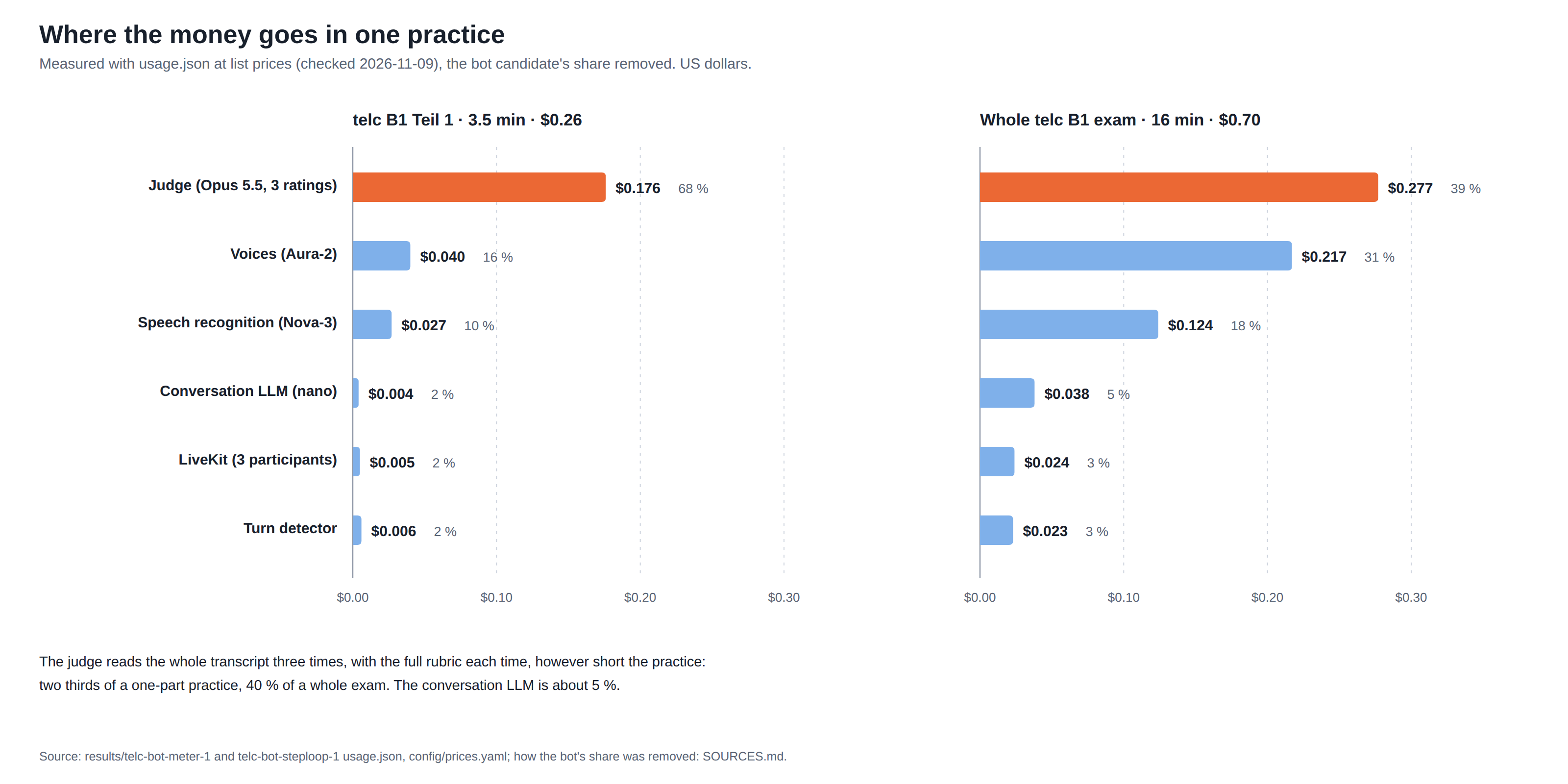
About NT$22 for a whole mock exam. Before I metered it, I had estimated $0.49; the judge ($0.28 measured, $0.13 assumed) and the voices (7,244 characters, about 45 % more than I assumed) were the two items I got wrong. The judge is the largest item: 40 % of a whole exam and two thirds of a one-part practice, because each of its three ratings carries the full rubric and instructions however short the practice was. The conversation LLM is only about 5 %. The 20-minute preparation costs nothing, because no call is open during it.
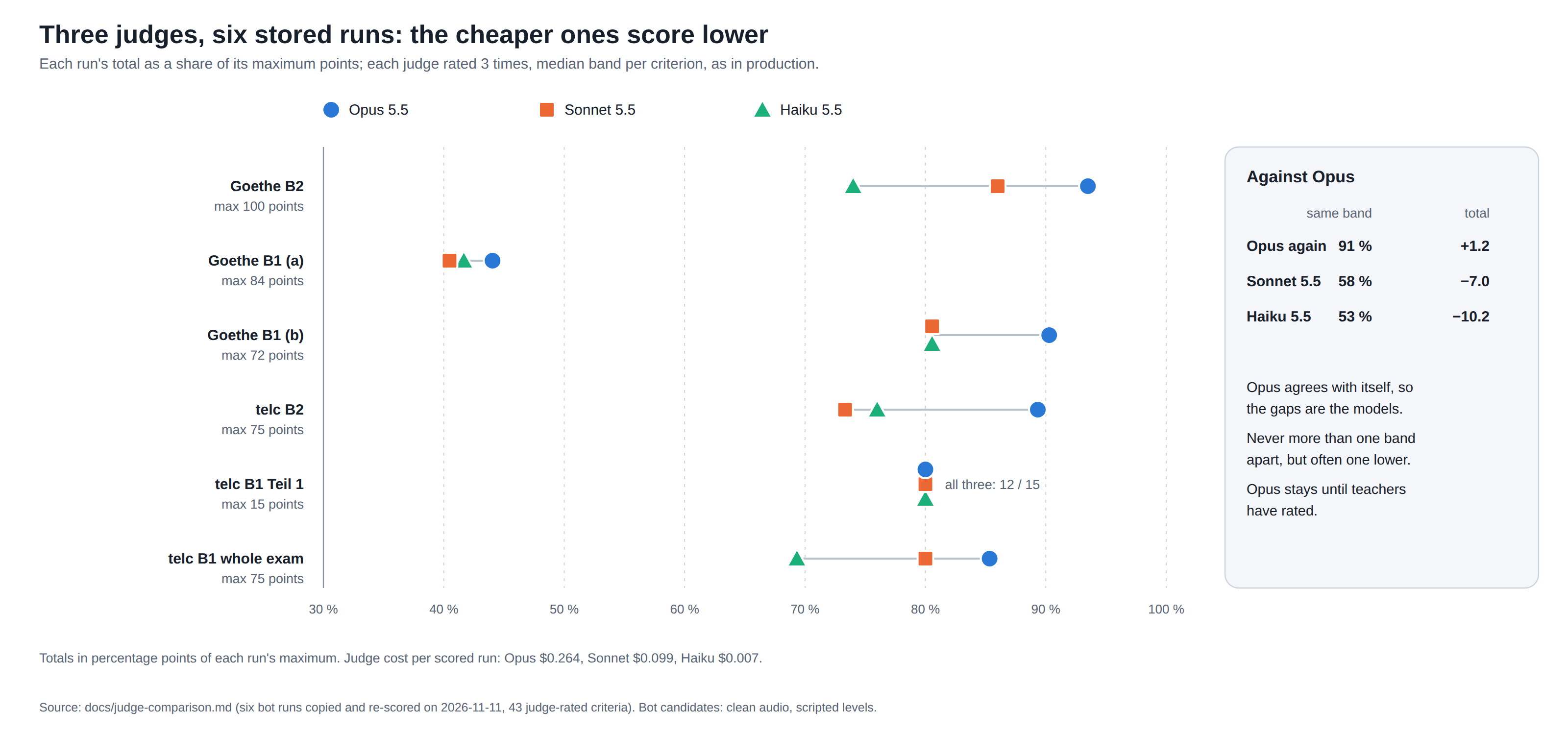
I tested the obvious lever, a cheaper judge, on six stored runs re-scored with today's code
(docs/judge-comparison.md, $2.2). Opus 5.5 scored again agreed with its earlier bands 91 % of
the time, so the gaps below are the models, not noise. Sonnet 5.5 matched Opus on 58 % of the
bands and scored 7 points lower on average (up to 16). Haiku 5.5 matched 53 % and scored 10 lower
(up to 20). Both were stricter, never wildly wrong. Switching would change what learners see, not
just the bill, so Opus stays until teachers have rated enough transcripts to say which judge is
closer to them.
The levers that do not change the scores come first: caching the judge's repeated prompt, a third rating only when the first two disagree, and pre-synthesized audio for the examiner's fixed lines.
Beyond telc B1
The same engine now runs more than one exam. Each format is a YAML file with a step flow:
dialogue, monologue (the AI stays silent while you present) and a partner who gives her own talk.
telc B1, A2·B1 and B2 run on it, and so do Goethe-Zertifikat B1 and B2, with task sets written in
the official format by us, because official task material may not be reused commercially. Around
it there is an invite-only trial with credits and the metering behind the table above, feedback in
the learner's language (繁中, Deutsch or English) with the corrections in German, three minutes of
telc B1 Teil 1 without an account at /try, and pages where a teacher rates a pseudonymised
transcript band by band before seeing the AI's score. Nobody has rated yet, which is why the judge
comparison above is against Opus and not against teachers.
What comes next
- Teacher ratings: about 30 rated transcripts per format before I describe the scores as "within one band of a teacher".
- Cost without changing scores: the judge and voice levers above.
- A worker pool instead of a CLI per exam: a long-running worker on its own droplets, with the web server dispatching jobs through the LiveKit API. That removes the one-call limit.
- TestDaF: recorded answers to a timer instead of a conversation, the cheapest format to run.
What I would ask LiveKit for
These come from places where I lost hours, not from a wish list.
- Say when a default drops something. A log line when an agent session ignores a participant
because of
participant_kinds, and a warning whenset_attributes()is called withoutcan_update_own_metadata. Both cost me a debugging session with no error to start from. - Listener-side latency.
e2e_latencystarts atstopped_speaking_atand ends when audio leaves the agent. A documented offset, or an optional measurement at a subscriber, would save everyone from building their own observer. - Mark preemptive replies in the metrics. A flag on the turn would make the latency numbers add up without guessing.
- A turn-length budget as a first-class option. Every model I tried ignored "three sentences".
A
max_sentenceson the agent, or a documentedllm_noderecipe, would make that the default path rather than an override. - Clearer free-tier failures. A 429 on the STT handshake closed the session as unrecoverable. An error that names the plan limit would have saved a lot of confusion.
- A light import path.
import livekit.agentstakes about 1.4 s, most of it in modules a given program never uses. Lazy imports for the inference and telemetry modules would make small helper scripts on the same codebase start fast.
I learned more about real-time voice from this one practice tool than from any tutorial. The model was the easy part; the time went into timing, silences and defaults. If you are building on LiveKit and want to compare notes, I would like to hear from you.