
Disclosure: I'm a Solutions Architect at DigitalOcean, so when I mention DigitalOcean products it's an informed-insider view, not a neutral one — I flag those moments clearly and keep the analysis vendor-neutral wherever the topic allows. The opinions here are my own.
Language learners pause. They pause in the middle of a sentence while they look for a word, and they pause just as often right after a sentence that is grammatically complete: "Ich komme aus Taiwan. [2 s] Also, ich wohne jetzt in Köln." To a turn detector trained on fluent speech, that second pause sounds like the end of a turn.
My mock speaking exam, Losreden (part 1 describes how it is built on LiveKit Agents), has an AI exam partner. In an exam, the most unfair thing she can do is take the floor in the middle of the candidate's thinking pause. So I set up a lab to find out how often she did that, and which settings stop it.
The lab took 58 calls and cost $8.09. It also found two bugs in my own harness. The result I did not expect: the LLM's speed is part of the turn-taking policy. With the old settings, the partner cut into learners' pauses twice as often after midnight as before it, because the LLM provider was faster at night.
Everything here is from livekit-agents 1.8.11, a scripted learner and telc B1 Teil 1 (getting to know each
other). The full build log, with every run, is docs/turnlab-buildlog.md in the repository.
TL;DR
- The test: eight LiveKit turn-taking settings, 40 calls with a scripted, synthesized B1 learner who pauses the same way every time, measured by a hidden observer in the room. The whole lab took 58 calls and $8.09.
- A 3.0 s
false_interruption_timeoutwas the clearest win: the partner resumed over a learner's "Äh, ähm." in 15 of 15 cases at 2.0 s and 3 of 15 at 3.0 s. - Adaptive barge-in was worse for learners, and dynamic endpointing did not help within one part of an exam: it starts low, learns slowly, and resets at every
update_agent(). - The LLM's speed is part of the policy. With
min_delaybelow the LLM's time to first token, the old settings cut into 29 % of finished-sentence pauses before midnight and 64 % after, because the provider got faster. - What I chose: fixed 2.0 / 5.0 s, timeout 3.0 s, VAD barge-in. It cut into 13 % of all pauses against 50 %, and the price is a reply about 1 s later.
The advice I started from
A thread on the LiveKit community forum about turn detection for non-native speakers gave four suggestions:
- Use dynamic endpointing (
mode: dynamic, min_delay: 0.5, max_delay: 5.0), so the agent learns how long this speaker pauses. - Raise
false_interruption_timeout(default 2.0 s) to about the length of a learner's pauses. - Prefer VAD barge-in over the adaptive interruption model, which was presumably trained on native speakers who backchannel. Learners hardly do.
- Measure against where the speaker really stopped, not against the framework's own end-of-speech.
All four sound right, and I could have flipped them on and called it done. I read the installed source first, because it costs nothing.
What the source said that the thread did not
Five things changed the experiment before I made a single call:
- The adaptive interruption model was never on. When the interruption mode is not set and the worker
runs in production mode,
AgentActivity._resolve_interruption_detectionreturns no detector. Every exam job logsadaptive interruption is disabled by default in production mode. So my exams already used VAD barge-in. For me, the condition to test was turning adaptive on. - Dynamic endpointing forgets at every handoff.
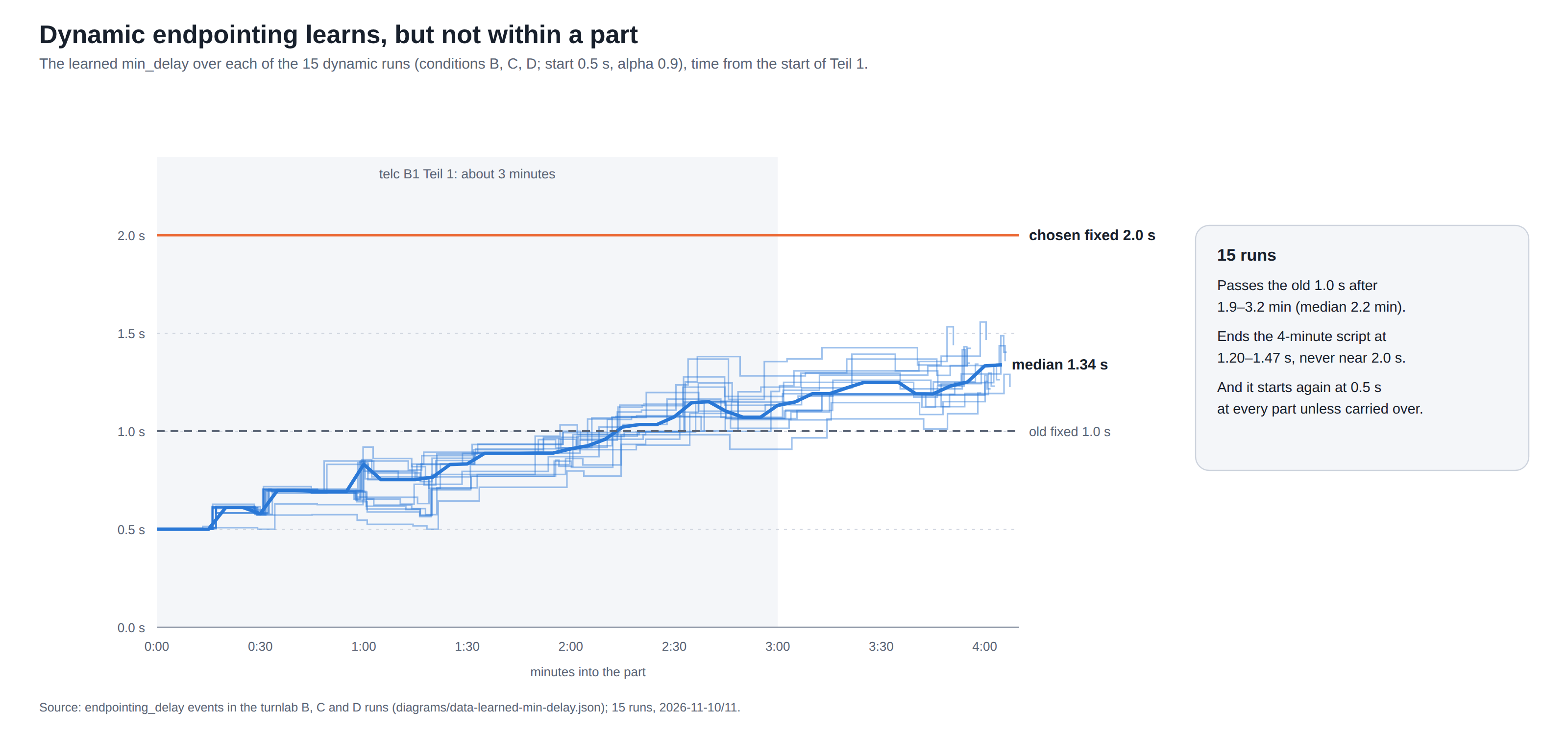
AgentActivity.startbuilds a new endpointing object, andsession.update_agent()starts a new activity. My exam switches agents at every part (three in telc B1, seven steps in Goethe B1), so what it learned about a candidate in Teil 1 is gone in Teil 2. I added a carry-over: read the learned value before the switch and pass it on withsession.update_options(endpointing_opts={"min_delay": learned}). - Dynamic starts lower than what I had. It learns
min_delayupward from the configured value (an exponential moving average with alpha 0.9, so each pause moves it 10 % of the way) and never goes below it. My fixed delay was 1.0 s, and the suggested floor is 0.5 s. Until it has seen a few pauses, it is quicker to cut in. - Which pauses
min_delayis for. With the turn detector,max_delay(5.0 s) applies when the model thinks the sentence is unfinished, andmin_delaywhen it thinks the turn may be over. So pauses in the middle of a sentence are mostly the detector's job.min_delaymatters after a finished sentence, which is exactly where a learner stops to think. - What counts as a false interruption. On a barge-in the agent pauses its audio. A final transcript with
words turns that into a real interruption. Only a barge-in without words ends in
false_interruption_timeout: a lone "Ähm" that the STT drops. Then the agent resumes its sentence, over a learner who is still looking for the next word. One more detail:interruption.min_durationis 0.5 s, so a short "Ähm" does not interrupt at all. My first synthesized "Ähm." was 0.30 s long. The script uses longer fillers.
The harness: a learner who pauses the same way every time
An LLM bot would pause differently in every run, so I wrote a scripted learner instead. It has 16 turns for telc B1 Teil 1. Each chunk of speech is synthesized once with Deepgram Aura-2 and cached, with the leading and trailing silence cut. Every condition therefore hears the same audio with the same silences:
- 9 pauses after a finished sentence, 7 in the middle of one, and 3 after a filler, each 1.2–3.0 s;
- 4 turns that start while the partner is talking (a barge-in) and then pause.
The learner is a plain room participant. It sends a steady 10 ms frame stream, like a microphone. It knows
when she has finished from her lk.agent.state, and it reacts after 0.7 s.
Measured from outside. The numbers come from a hidden observer in the room. It runs an energy VAD on both
tracks and stamps each frame on arrival. On LiveKit Cloud, a smoothed frame clock was 90 ms off where
arrival stamps were 3–5 ms off; I found that when I validated the observer on Cloud. A pause counts as cut if her voice
is heard after the pause began and before the learner's next chunk is over. For a barge-in I measured how
long she kept talking, and whether she started again inside the same turn (resumed over). I checked that
against the framework's own agent_false_interruption(resumed=true) events.
Every new setting went into config with the old behaviour as the default. A test checks that the defaults still produce exactly the old options.
Two bugs in my own harness
The first smoke run (old settings, $0.16) gave a loud number: the partner took the turn in 8 of 9 pauses after a finished sentence. That would have made a great headline. It was my bug.
Printing the timeline, instead of trusting the table, showed the learner's clock was bimodal: its lag to the observer was either 0.17 s or about 0.8 s. The network was not the cause; the end-of-chunk lag was a steady 0.14 ± 0.01 s. Aura-2 starts some clips with a 10 ms click at −42 dBFS and then about 0.75 s of silence, and my trim kept everything after the first voiced window. So some "exact" pauses were 0.75 s longer than scripted. With the trim starting at the first 50 ms run of speech, the baseline cut in after 1 of 9 finished sentences, not 8.
The second bug: barge-ins came too late. The learner judged "she is talking" from her audio energy, which
drops between her sentences, so 2 of 4 barge-ins landed in a gap or after she had finished. The learner now
uses her lk.agent.state, which says "speaking" for the whole reply.
The other lesson from the smoke runs: one run per condition says nothing. Two runs of the same settings cut into 21 % and 32 % of all pauses. From then on, every condition got 5 runs, interleaved (A1 B1 C1 … A2 B2 …), about 5 minutes and $0.14 each.
Eight conditions, 40 calls
Per condition: 45 pauses after a finished sentence, 35 in the middle of one, 15 after a filler and 20 barge-ins. Gap is the time from the learner's last word to her voice.
| Setting | Cut-in after a finished sentence | Mid-sentence | Resumed over the learner (barge-ins) | Gap median / p90 | |
|---|---|---|---|---|---|
| A | old: fixed 1.0 / 5.0 s, VAD barge-in, timeout 2.0 s | 29 % | 0 % | 75 % | 2.95 / 6.75 s |
| B | dynamic 0.5 / 5.0 s | 33 % | 3 % | 75 % | 2.81 / 6.72 s |
| C | B + timeout 3.0 s | 36 % | 9 % | 15 % | 2.85 / 7.01 s |
| D | C + adaptive barge-in | 29 % | 14 % | 90 % | 2.80 / 5.93 s |
| E | fixed 2.0 / 5.0 s | 22 % | 9 % | 70 % | 3.95 / 5.85 s |
| F | A, resume off | 80 % | 20 % | 0 % | 2.19 / 5.82 s |
| G | A + timeout 3.0 s | 64 % (see below) | 9 % | 25 % | 2.63 / 5.92 s |
| H | fixed 2.0 / 5.0 s + timeout 3.0 s | 22 % | 3 % | 30 % | 3.67 / 6.65 s |
Point by point against the forum advice:
-
Dynamic endpointing did not help within one part of an exam. B against A, 33 % against 29 %, is inside the run-to-run spread. It starts at 0.5 s, passes the old fixed 1.0 s only after about two minutes (1.9–3.2 min), and ends the four-minute script at 1.2–1.5 s, nowhere near 2.0 s. telc B1's Teil 1 lasts about 3 minutes. The carry-over fixes the reset at each part, not the slowness.
-
A 3.0 s
false_interruption_timeoutis the clearest win. A learner who says "Äh, ähm." and then searches for words for 2.4–3.0 s had the partner start her sentence again over them in 15 of 15 cases at 2.0 s, and in 3 of 15 at 3.0 s (B against C). The thread was right. -
Adaptive barge-in is worse for learners, as the thread guessed (D against C). It classifies "Äh, ähm." and "Ja, aber …" as backchannels, so she keeps talking for 0.9 s (0.6 s with VAD) and resumes in 18 of 20 barge-ins. None of those went through the false-interruption timer: a backchannel verdict resumes her at once, so a longer timeout does not help there.
-
Measuring from the room changed the answer. Condition F turned off
resume_false_interruption, and cut-ins after finished sentences went from 29 % to 80 %. She is not quicker in F. With resume on, a reply committed just before the learner goes on is paused before its first audio frame and then dropped when the learner's words arrive, so the learner never hears it. With resume off nothing pauses, and she gets 0.1–0.6 s of speech out before the learner's voice interrupts her. The framework's owninterruptedcount looks the same either way. Only a listener in the room hears the difference.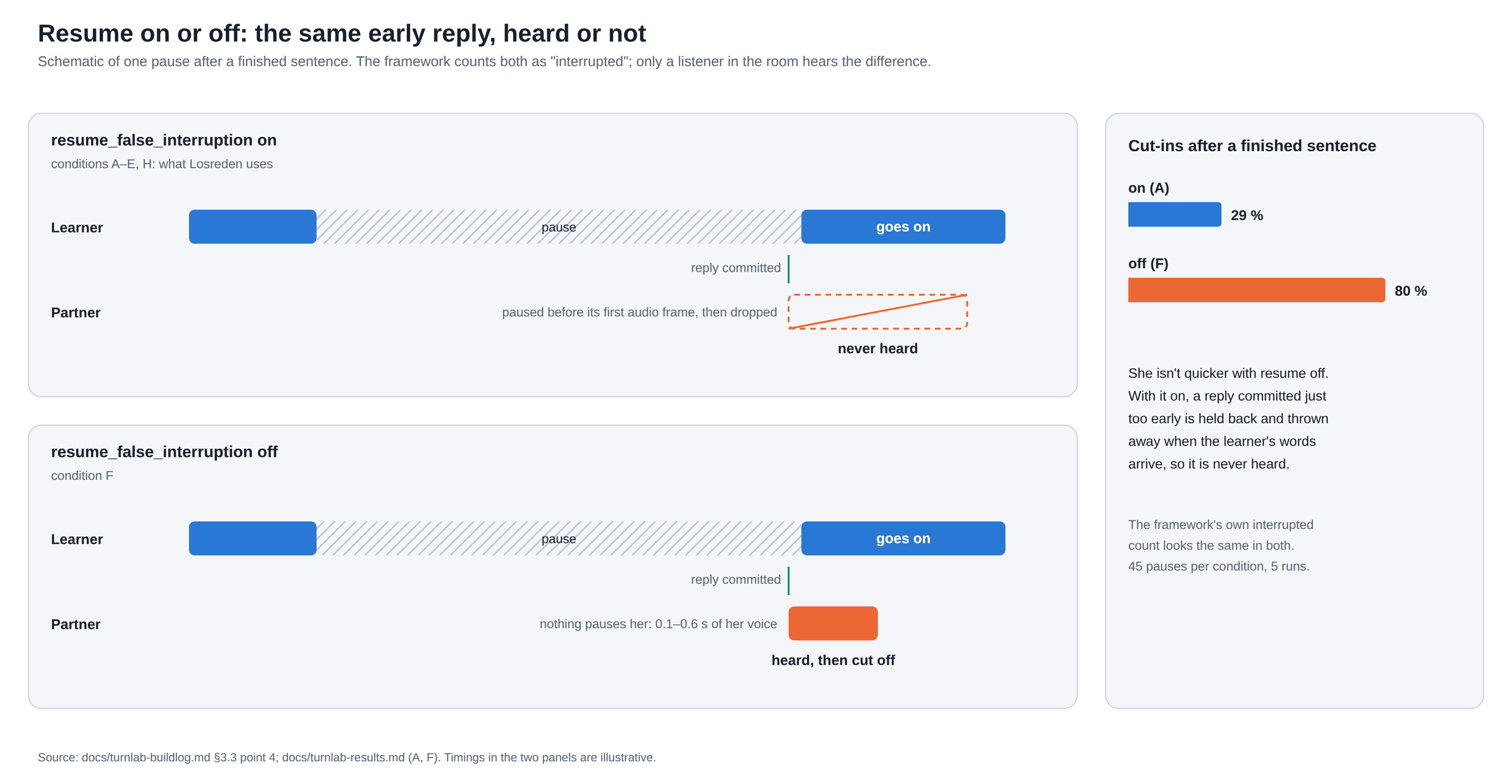
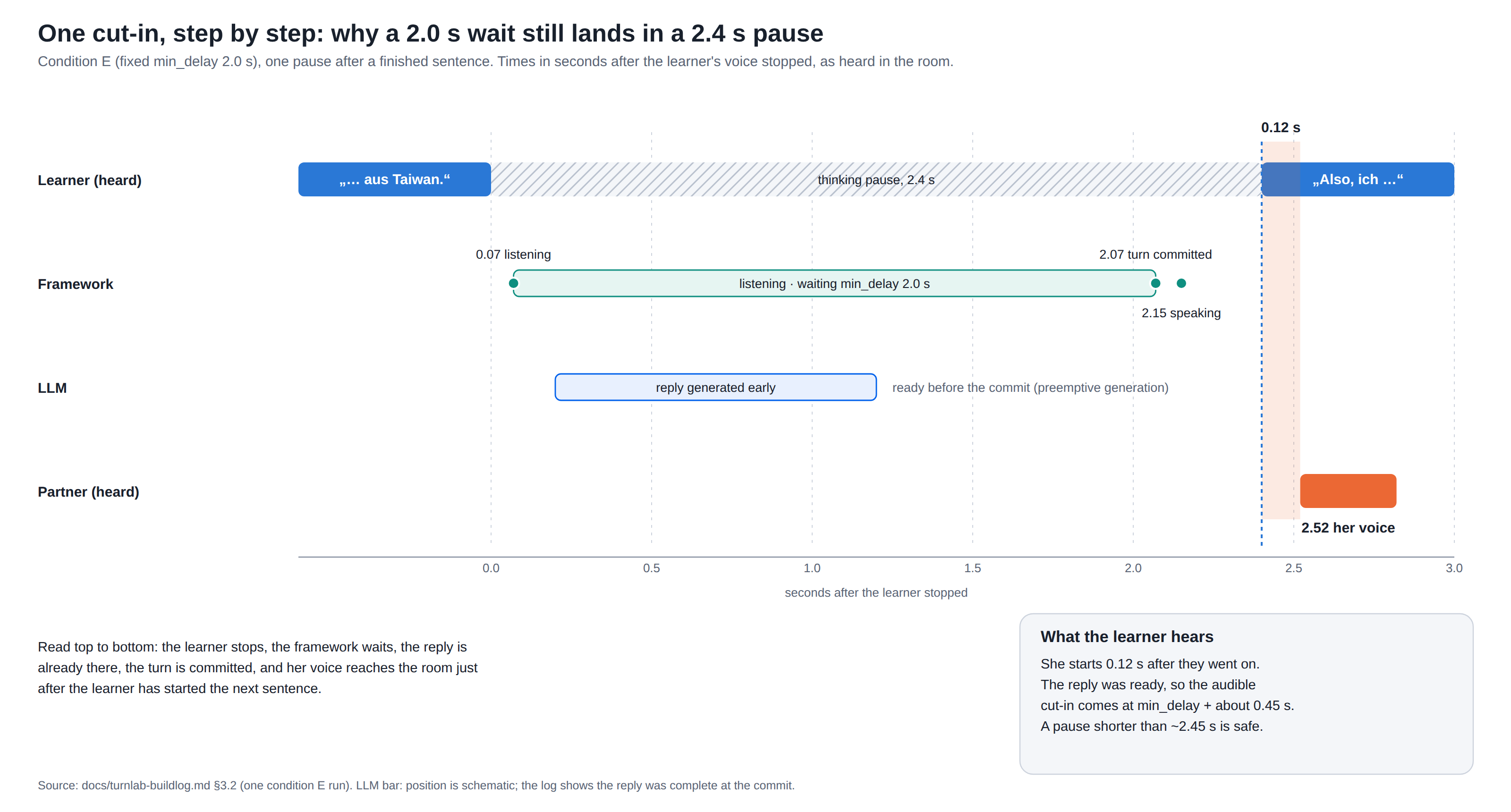
One trace shows why even a 2.0 s min_delay can cut into a 2.4 s pause. The learner stops at 0.00. The
framework's user state turns listening at 0.07. The turn is committed at 2.07, the agent is speaking at
2.15, and her voice is heard at 2.52, 0.12 s after the learner went on. Preemptive generation had the reply
ready at the commit, so the audible cut-in comes at about min_delay + 0.45 s.
The finding I did not expect: the LLM's speed is part of the policy
Condition G cut in after 64 % of finished sentences, against 29 % for A. G only adds the longer timeout, which has nothing to do with endpointing; C against B showed no such jump. The difference was the hour. A to E ran from 21:57 to midnight, F to H from 00:02 to 01:15. After midnight, the LLM on DigitalOcean Serverless Inference got faster: its median time to first token went from 1.05 s to 0.87 s.
So I ran a control in one window (01:16–02:36): A, G, H and a new I (fixed 1.5 s), interleaved, 4 runs each.
| Setting | Cut-in after a finished sentence | All pauses | Resumed over "Ähm" | Her voice per cut-in | Gap median / p90 | |
|---|---|---|---|---|---|---|
| A | old: fixed 1.0 s, timeout 2.0 s | 64 % (29 % before midnight) | 50 % | 100 % | 0.55 s | 2.64 / 6.60 s |
| G | fixed 1.0 s, timeout 3.0 s | 61 % | 36 % | 25 % | 0.53 s | 2.72 / 6.57 s |
| I | fixed 1.5 s, timeout 3.0 s | 44 % | 28 % | 25 % | 0.55 s | 3.10 / 5.82 s |
| H | fixed 2.0 s, timeout 3.0 s | 22 % | 13 % | 17 % | 0.22 s | 3.68 / 6.37 s |
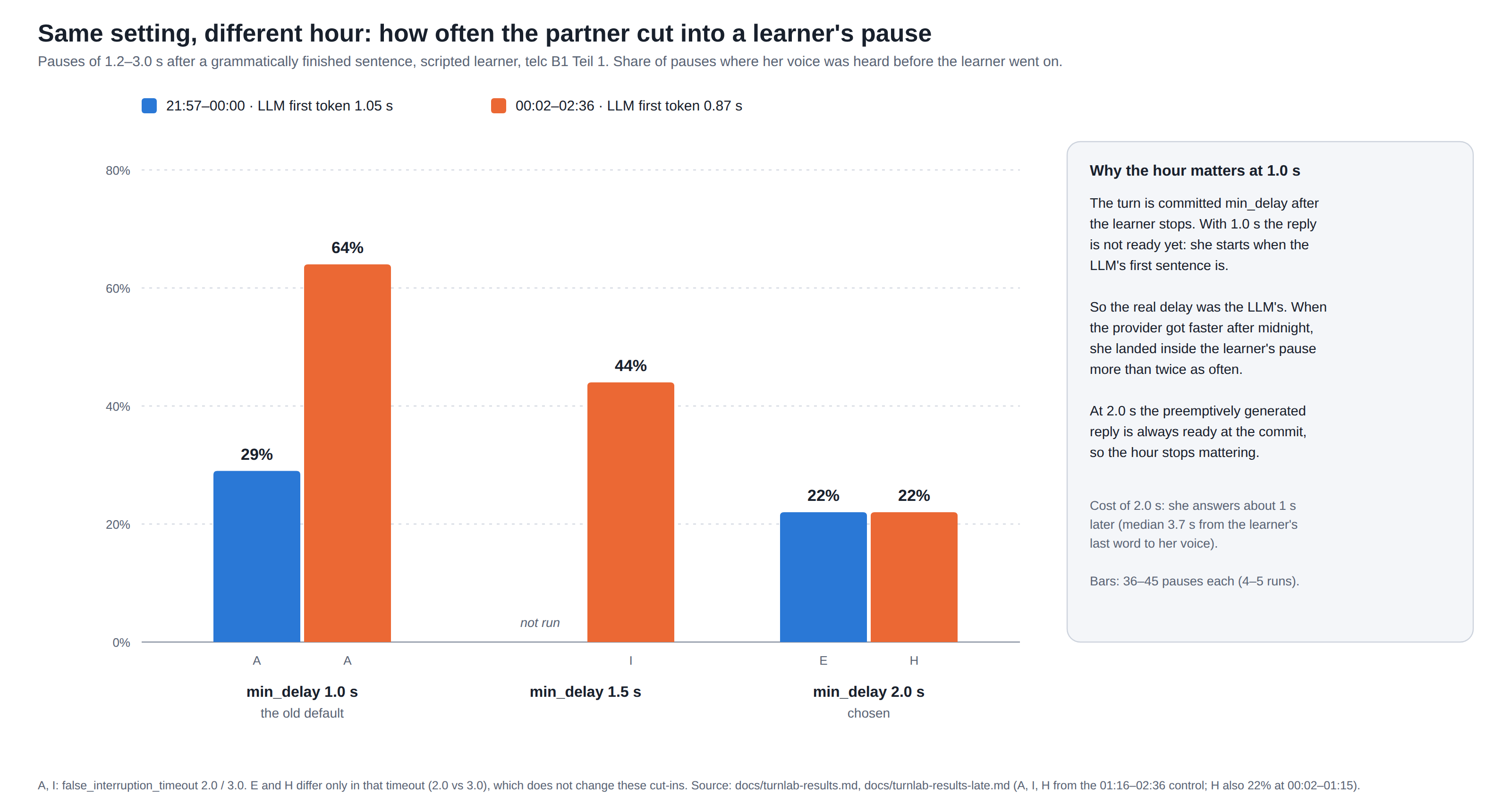
The mechanism: with min_delay at 1.0 s, the reply is not ready when the turn is committed, because it
needs about 1.05 s. She starts about 1.2 s after the commit, so the learner hears her about 2.7 s after they
stopped. The old settings' apparent patience came from the LLM being slow. When the provider is faster, she
starts about 0.35 s after the commit and lands inside the learner's pause. With min_delay at 2.0 s, the
preemptively generated reply is always ready at the commit, so she is heard about 2.7 s after the learner
stopped whatever the provider does that hour. The fixed 2.0 s delay gave 22 % before midnight (E) and 22 %
after it (H, in both windows).
The lesson for anyone tuning this: if min_delay is below your LLM's time to first token, your real
delay is the LLM's, and it moves with the provider's load. Measure at more than one time of day.
What I chose, and what it costs
telc:
  turn_taking: {mode: fixed, min_delay: 2.0, max_delay: 5.0}
  interruption: {mode: null, false_interruption_timeout: 3.0}
yaml- Fixed, not dynamic. Dynamic starts below what learners need and learns too slowly for a 3–6 minute part. Dynamic mode and the carry-over stay in the code as options.
- VAD barge-in, not adaptive. A learner's filler is not a backchannel.
- Resume stays on. It is what keeps a reply that comes just too early from being heard at all.
- The price: she answers about 1 s later, a median of 3.7 s from the learner's last word to her voice (p90 6.4 s). For an exam partner that is the right side to err on. telc's own guidance is that the examiner lets the candidate finish. If it feels slow in practice, 1.5 s (condition I) is the next step down, at about twice the cut-ins.
In the same hour, the chosen settings cut into 13 % of all pauses against 50 % for the old ones. After a learner's "Ähm", she resumed over them 17 % of the time against 100 %. The settings went live on 2026-11-11 after one whole-exam check.
What this does not cover. One voice, one script and one task type, with the clean audio of a synthesized learner. Real learners pause in more places and for longer. Teachers rating real transcripts is the next check (see part 1).
What I would ask LiveKit for
- Keep what dynamic endpointing learned across
update_agent(), or document that it resets. A multi-agent flow loses it at every handoff today. - Say in the docs that
min_delayis a floor, not the delay. Below the LLM's time to first token, the provider's latency sets the real delay, and that changes with the hour. - An "audible" flag on interruption metrics. A reply that was paused before its first frame and dropped
counts as
interruptedjust like one the user heard. A flag would let people see what F showed without building an observer. - A note on adaptive interruption and non-native speech. Fillers like "Äh, ähm." are classified as backchannels. That is fine for fluent speakers and wrong for learners. It is off by default in production mode, which is the right default, but the reason is worth a sentence.
Reading the source before the first call saved me from testing a setting that was already off, and printing timelines instead of trusting the summary table caught both of my own bugs. The result I was not looking for only showed up when I ran the same test at a different hour.